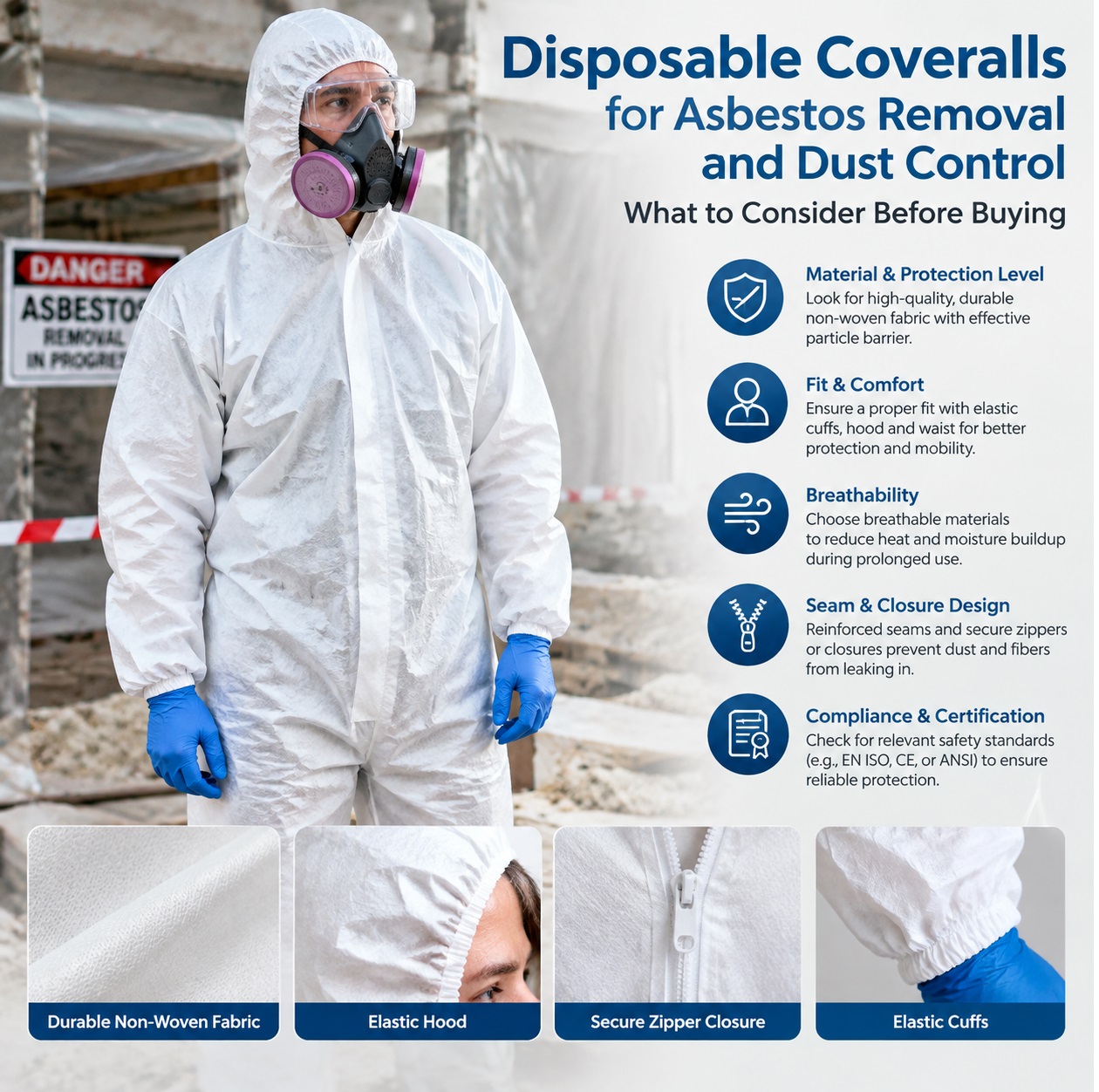
 Nobody ever got yelled at for choosing the wrong respirator. They got yelled at because the coverall ripped under the arm on day two, or the hood wouldn’t sit right over a half-mask, or the whole crew was overheating by 10 a.m. and started unzipping “just for a minute.”
If you’re buying disposable coveralls for asbestos work or heavy dust control, you’re not shopping for clothing. You’re shopping for the last line of defense between a fibre and somebody’s skin, hair, and car seat. Here’s what actually matters, and where cheap usually turns expensive.
Start With the Type, Not the Price
The single most common purchasing mistake is treating “disposable coverall” as one product. It isn’t. Two categories dominate this work:
Type 5 (EN ISO 13982-1) is for airborne solid particulates. This is the one you want for asbestos, and it’s the standard that actually speaks to fibre penetration. It’s tested for inward leakage of aerosolized particles across the whole suit, not just the fabric.
Type 6 (EN 13034) is for limited liquid splash. Useful for wet removal methods, contaminated water, and general dust control, but on its own it isn’t a particulate barrier claim.
If a supplier can’t tell you which type you’re buying, and can’t produce the test report, that’s your answer. Walk away. Plenty of listings online slap “asbestos suit” on a product that has never been through a Type 5 panel test.
Seams Are Where Cheap Coveralls Fail
Look at the seam construction before you look at anything else.
Serged seams are stitched, fast, and cheap. They’re fine for low-risk dust work. They are not what you want on a full asbestos enclosure job.
Bound or taped seams cover the stitch line with a strip of material, sealing the holes the needle made. Taped seams cost more. They also happen to be the difference between a suit that holds up and a suit that leaks at the shoulder every time the wearer raises their arms.
If you’re pricing two options and one is dramatically cheaper, check the seams first. That’s usually where the money went.
Fabric Choice: Comfort Is a Safety Issue
SMS (spunbond-meltblown-spunbond) breathes. Microporous film laminated to a nonwoven backing blocks more, but it also traps heat like a plastic bag.
In a hot enclosure, in summer, with a full-face respirator on, heat stress takes people out faster than the contaminant does. A worker who’s dizzy and nauseous is a worker who makes mistakes during doffing, and doffing is where most self-contamination happens.
For long, warm jobs, breathable SMS with taped seams usually wins. For short, wet, or highly contaminated tasks, the higher-barrier film laminates earn their place. Match the fabric to the job, not to the invoice.
The Details That Decide Whether It Gets Worn Properly
A few features separate a coverall people actually wear correctly from one they fight with:
An attached hood that fits over a respirator without pulling the mask off-center.
Elastic at the wrists, ankles, and face opening. Loose cuffs let dust in and snag on everything.
A zipper covered by a storm flap, ideally with a self-adhesive tab at the top so the closure stays sealed.
Zero chest pockets. Pockets on a disposable coverall are just little dust collection bins that also catch on scaffolding.
Thumb loops, if your crew is taping gloves. They stop sleeves riding up.
Sizing Is Not Vanity, It’s Engineering
Too small and the suit tears at the crotch and shoulders. Too large and the excess fabric snags, drags, and creates folds where contamination sits.
Order by the wearer’s chest and height, not by the size they buy at the shop. And buy a spread of sizes. A crew of ten men and women is not a crew of ten larges. If your supplier won’t send a size set for fitting before a bulk order, that’s a red flag, because getting this wrong means either returns or a pallet of unusable stock.
Anti-Static, If You’re Working Around Ignition Sources
Asbestos removal often happens in plant rooms, mechanical voids, and industrial buildings with live equipment nearby. Type 5 and 6 coveralls with anti-static treatment (tested to EN 1149-5) are worth specifying in those environments. It costs a little more and eliminates a conversation you don’t want to have with a safety officer.
Paperwork You Should Expect Without Asking
A serious supplier hands over, as standard:
The declaration of conformity and the notified body details.
The EU type-examination certificate or equivalent, with the correct PPE category (Category III for these products).
Test reports for the type claim, not just a marketing line.
Batch or lot coding on the packaging, so you can trace a problem back if there is one.
Care and use instructions in the language of the people wearing them.
If you have to chase any of that, you’re buying from a reseller who’s guessing.
The Cost Conversation Nobody Likes
The temptation is to buy the cheapest case of 50 and move on. Run the math differently: cost per protected worker-day, plus the cost of a failed inspection, a re-clean, or a medical surveillance flag.
A coverall that costs 30 percent more but survives a full shift without taping repairs, doesn’t cook the wearer, and has documentation you can hand to a regulator is cheaper by almost any measure that matters.
What to Ask Before You Place the Order
Which type, and can I see the certificate?
Serged, bound, or taped seams?
What’s the fabric weight and construction?
Does it come with a hood, and will it fit over your respirator model?
What sizes are in stock, and how fast can you replenish mid-project?
Can I get a sample set to fit before committing?
Do you hold stock, or am I waiting six weeks on a container?
That last one has killed more project schedules than any product defect. Asbestos jobs don’t wait, and a supplier who can ship a mixed-size pallet in 48 hours is worth real money when a deadline is closing in.
Buy the Suit Like You Mean It
The coverall is the piece of PPE most likely to be compromised and least likely to be inspected before it’s too late. It’s also the one people notice last, right up until the moment it fails.
Get the type right. Get the seams right. Get the sizing right, and buy from someone who can prove what they’re selling. Your crew will complain less, your doffing procedures will hold up, and your paperwork will survive a surprise visit. That’s what you’re actually paying for.